Fortinet User Group · November 3, 2026 · 20 minutes
Securing the Internet with RPKI
Every route on the internet is a promise. Almost nobody checks who’s making it.
Travis Stroebele · Network Architect · the long version is the full RPKI page
Press → or Space to advance · F full screen · P present/read
Sunday, February 24, 2008 · 18:47 UTC
YouTube disappears.
Not for Pakistan. For much of the world. And nobody at YouTube touched a thing.
The hijack, minute by minute
Two minutes to take it down. Two hours to get it back.
18:47 · The announcement
Pakistan Telecom (AS17557) originates 208.65.153.0/24, a slice of YouTube’s 208.65.152.0/22, and sends it to its upstream, PCCW (AS3491).
18:49 · The spread
PCCW accepts it without a filter and re-advertises it to the world. Within about two minutes the bad route reaches its widest spread.
20:07 – 20:18 · YouTube fights back
YouTube (AS36561) announces the same /24, then splits it into two /25s to win on longest-prefix match. Traffic starts coming home.
21:01 · The route is withdrawn
PCCW withdraws the Pakistan Telecom announcement it had been carrying to the world. YouTube is reachable again everywhere.
Sources: RIPE NCC case study; Renesys analysis, February 2008.
Why it worked
BGP believes whoever speaks most specifically
The real owner says
208.65.152.0/22 origin AS36561
“I am YouTube. Send me 1,024 addresses’ worth of traffic.”
The hijacker says
208.65.153.0/24 origin AS17557
“I am Pakistan Telecom. I have a more specific route for 256 of those addresses.”
YouTube’s /22 is four /24s. One more-specific announcement took a quarter of it.
Longest prefix match wins. Every router that heard the /24 picked it. Nothing in BGP asked: “Is AS17557 actually allowed to announce this?”
Part two · How routing really works
The internet is a network of networks that gossip
Autonomous System
One network under one administration: an ISP, a cloud, a university, a bank, you. Identified by an ASN, like AS36561 (YouTube) or AS10297 (eNet). The internet is roughly 80,000 of them.
Prefix
A block of IP addresses an AS is responsible for, written in CIDR: 208.65.152.0/22. Smaller number after the slash means a bigger block.
BGP
The Border Gateway Protocol. Each AS tells its neighbors “I can reach these prefixes, via this path.” Neighbors repeat it. There is no central authority.
Global routing table
The sum of all that gossip: over a million IPv4 routes from tens of thousands of ASes. Every full-table router on Earth holds its own copy.
Think of it as a postal service that trusts whatever return address you write on the envelope.
Who owns what
Addresses flow downhill from one root
Same ICANN, different job: domain names go ICANN → registries (.com) → registrars → you. Numbers go ICANN → IANA → RIRs. Two trees, one root. RPKI lives in the numbers tree.
Read more: the two trees under ICANN
Security people know ICANN from DNS: it accredits registrars and contracts with registry operators like Verisign for .com. The same organization operates the IANA functions: the master pools of IPv4, IPv6 and AS numbers. IANA delegates large blocks to the five RIRs, which allocate to members (ISPs acting as Local Internet Registries, and end users who qualify for provider-independent space). The RIR is therefore the authoritative record of who holds which block, and that chain of custody is exactly what RPKI puts a cryptographic signature on. The full story is on RPKI, RIRs, and Internet Governance.
The five registries
Five RIRs, five RPKI trust anchors
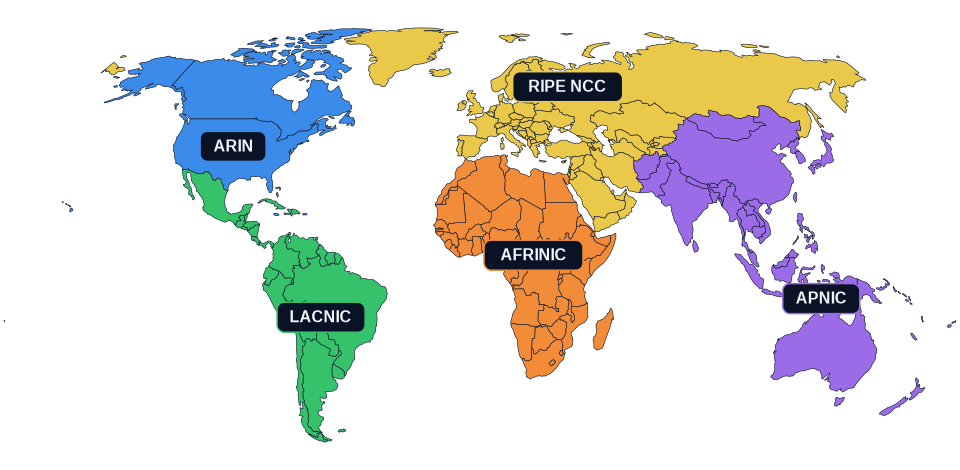
Each RIR publishes a Trust Anchor: the root certificate for every address block it has ever allocated. Your validator downloads all five. That is the entire root of trust for the global routing system. If you are in this room, your space and ASN live at ARIN.
Owning your own prefixes and ASN
Rent your addresses, or hold the deed
Provider-assigned · your ISP’s space
- Addresses come out of the carrier’s block
- Carrier announces them; you have no BGP
- Change carriers, renumber everything
- Carrier’s ROAs cover you, if they made any
Provider-independent · your own block + ASN from ARIN
- Multihome across two or more carriers
- Announce it yourself over eBGP
- Keep it forever, through every carrier change
- You are responsible for its ROAs
If you hold a /24 and an ASN and have never logged into ARIN Online to create a ROA, your block is unsigned: any AS on Earth can announce it and no validator will object.
Read more: getting your own space at ARIN
An ARIN Online account and Org ID; an ASN if you can show a plan to multihome or a unique routing policy; IPv6 is easy to justify; IPv4 means the waiting list or the transfer market through a Qualified Facilitator. Sign the RSA (or LRSA for legacy space), pay the annual Registration Services Plan fee, and the resources are registered to you. Fees and current policy are on the ARIN Fee Schedule. The RPKI services later in this talk require a signed (L)RSA.
How routes are learned
Announce. Propagate. Pick a winner.
64502 64501 64500, chooses| # | Rule | What it means in practice |
|---|---|---|
| 0 | Longest prefix match | Not even a BGP rule. The forwarding table always takes the most specific route. A /24 beats a /22 every time. |
| 1 | Local preference | Your own policy: prefer this carrier over that one. |
| 2 | Shortest AS_PATH | Fewer hops wins. Hijackers who are “closer” to a victim’s customers win more of its traffic. |
| 3 | Everything else | Origin type, MED, eBGP over iBGP, oldest route, lowest router ID. Tiebreakers. |
The problem in one sentence
BGP has no concept of truth.
Anyone can announce anything
A BGP session is a TCP connection and a password. Say a prefix, and your neighbor believes you.
Mistakes and malice look identical
A fat-fingered mis-origination and a deliberate hijack produce the same packets on the wire.
Filters are manual and optional
PCCW could have filtered Pakistan Telecom in 2008. They did not. Nothing forced them to.
Part three · Tuesday, April 24, 2018 · 11:05 UTC
Ten years later, someone did it on purpose.
The attack chain
Hijack the route. Poison the answer. Serve the clone.
205.251.192.0/24. Peers accept and spread them.Amazon’s statement: “Neither AWS nor Amazon Route 53 were hacked or compromised.” True. The attackers never touched Amazon. They just told the internet that Chicago was Amazon.
The certificate warning only held because the attackers didn’t bother. Own the route and you could pass a CA’s domain validation and get a real certificate. In 2022 someone did exactly that.
Read more: why there was no login to steal
MyEtherWallet is a client-side wallet. There is no account, username or password on a server; you unlock a wallet in the browser by pasting a private key, uploading a keystore file and its passphrase, or plugging in a hardware wallet. So the attackers did not need to break authentication. They served a look-alike front end from a server in Russia, and anyone who clicked past the certificate warning and unlocked their wallet handed over the one secret that matters. With the keys, the attackers signed their own transactions: about 215 ETH, roughly $150,000, into an address Etherscan had already flagged for earlier phishing campaigns. A password can be reset; a private key cannot. Hardware-wallet users were safe, because the key never left the device, though a malicious page could still have swapped the destination address on a transaction they signed.
The padlock was never a real defense. A domain-validated certificate is issued to whoever can answer the CA’s challenge, by serving a token over HTTP or in a DNS TXT record. The attackers controlled the route to myetherwallet.com’s authoritative DNS, so for any CA whose validator sat on the hijacked side of the internet, the rogue server could simply answer the challenge. Nothing in the real zone changes; the CA just never reaches it. Free, automated CAs make that a two-minute script. The 2018 crew used a self-signed cert anyway, which is why a browser warning was all that stood between visitors and a silent theft. In February 2022 the KLAYswap attack in Korea did it properly: a BGP hijack, a validly issued certificate, malicious JavaScript over trusted HTTPS, about $2M stolen (see the full page). Let’s Encrypt began validating from multiple vantage points in 2020, and the CA/Browser Forum made multi-perspective validation mandatory for public CAs from 2025, so a hijack that fools only part of the internet now fails the check. DNSSEC would have broken the chain at step 3; HSTS would not have helped against a valid certificate.
Sources: Oracle Internet Intelligence; Internet Society / MANRS; Cloudflare; The Register; BleepingComputer; Help Net Security, April 2018.
Two incidents, one root cause
Same trick. Different decade. Different motive.
| 2008 · Pakistan Telecom vs YouTube | 2018 · eNet vs Amazon Route 53 | |
|---|---|---|
| Intent | Accidental: a domestic block that leaked | Deliberate: a targeted financial heist |
| Technique | More-specific /24 of a /22 | More-specific /24s of Amazon’s blocks |
| Who let it through | PCCW, one upstream with no filter | Several peers that accepted eNet’s routes |
| Victim could fix it? | Only by out-announcing and phone calls | Only by waiting for withdrawal |
| Duration | About 2 hours | About 2 hours |
| Would RPKI have stopped it? | Yes. AS17557 was never authorized for that prefix. | Yes. AS10297 was never authorized for Amazon’s space. |
In both cases a single question, asked automatically by the routers that received the announcement, would have ended it before it started: is this AS allowed to originate this prefix?
Part four · The fix
RPKI puts a signature on “I own this.”
Resource Public Key Infrastructure
A certificate hierarchy rooted at the five RIRs that proves which organization holds which IP blocks and ASNs. The same chain of custody from the hierarchy slide, now cryptographic.
Route Origin Authorization (ROA)
A signed statement by the holder: “AS36561 may originate 208.65.152.0/22, and nothing more specific than a /22.” Published by the RIR, fetched by everyone.
How it works end to end
Sign at the registry. Validate at the router.
VALID
A ROA covers the prefix, origin AS matches, length within max. Accept.
INVALID
A ROA covers it, but wrong origin or too specific. Drop it.
NOT FOUND
No ROA at all. Accept, same as today. This is the unsigned third of the internet.
Replay the tape with RPKI on
Both hijacks die at the first validating router
2008 · YouTube
ROA: 208.65.152.0/22 AS36561 max /22 BGP: 208.65.153.0/24 origin AS17557
INVALID, twice over. Wrong origin AS, and a /24 is more specific than the /22 max length. PCCW drops it on ingress. Pakistan blocks YouTube for Pakistan, and nobody else notices.
2018 · Route 53
ROA: 205.251.192.0/21 AS16509 max /21 BGP: 205.251.192.0/24 origin AS10297
INVALID, twice over. Wrong origin, too specific. eNet’s peers drop it. DNS queries keep flowing to the real Route 53. The phishing server in Chicago never sees a packet.
The maxLength trap: set it to exactly what you announce. A loose maxLength (a /22 ROA allowing /24s) means a hijacker who forges your origin ASN can announce a /24 that validates and wins on longest match.
The ROA values shown are illustrative. The outcome is not: in both cases the announcement fails origin validation on every router that checks.
Where we are today
The internet is two-thirds signed. The rest is on us.
Rejecting invalids is now standard at the big carriers, clouds and exchanges. The remaining third of unsigned space is overwhelmingly held by enterprises, governments and schools. People like us.
Sources: IPinfo RPKI report, Sep 28 2026; ARIN 58 routing security update, Oct 2026 (NIST RPKI Monitor data).
Being honest about scope
RPKI checks the origin. Not the whole path.
What it stops
- Wrong-origin hijacks (2008, 2018)
- More-specific hijacks via max-length
- Most fat-finger mis-originations of your space
What it does not
- A forged path that keeps the real origin at the end
- Route leaks with a valid origin through the wrong transit
- Anything after the route: DNS, TLS, phishing
What is coming
- ASPA: sign who your providers are, narrowing the leak and path-forgery gap
- Pair with DNSSEC and HSTS to close the 2018 chain end to end
- MANRS: the operator norms that make all of this standard
Part five · Your part
Everyone in this room can do something this week
Everyone · ask your ISP two questions
- “Do you drop RPKI-invalid routes on every peer and transit?”
- “Are there ROAs for the space you assigned us?”
- Put both in your next RFP and contract renewal
- If all you take from your ISP is a default route, validation is their job. You cannot do it for them.
If you hold a prefix or ASN · create your ROAs
- ARIN Online → Routing Security → Hosted RPKI
- One ROA per prefix you announce, origin = your ASN
- Max length = exactly what you announce
- Verify with a looking glass before and after
If you run BGP at your edge · validate what you accept
- Stand up a validator (Routinator, FORT, rpki-client)
- Point your edge at it over RTR
- Reject invalid; treat not-found like today
- Sign the MANRS pledge and tell your peers
What it looks like on the box
A dozen lines of config. That is the whole deployment.
config router bgp
    set route-origin-as-validation enable
    config rpki-server
        edit "rtr1"
            set addr "10.0.0.53"
            set port 3323
            set preference 10
        next
        edit "rtr2"
            set addr "10.0.0.54"
            set port 3323
            set preference 20
        next
    end
end
router bgp 64500
bgp rpki server tcp 10.0.0.53 port 3323 refresh 300
bgp rpki server tcp 10.0.0.54 port 3323 refresh 300
address-family ipv4 unicast
bgp bestpath prefix-validate disable
neighbor 203.0.113.1 soft-reconfiguration inbound
neighbor 203.0.113.1 route-map ISP-IN in
!
route-map ISP-IN deny 10
match rpki invalid
route-map ISP-IN permit 20# FortiOS 8.0.1
get router info bgp rpki server-summary
get router info bgp rpki table-ipv4
get router info bgp rpki validate 192.0.2.0/24 64500
! IOS XE
show ip bgp rpki servers
show bgp ipv4 unicast rpki table
show bgp ipv4 unicast rpki invalidRead more: platform notes
FortiOS: per Fortinet’s documentation, BGP RPKI origin validation is new in FortiOS 8.0.1. It is CLI-only, configured per VDOM, RTR over plain TCP only, with one active cache per VDOM and the others as failover by preference (lower wins). With route-origin-as-validation enable, routes marked Invalid are rejected and not installed; Valid and NotFound are installed. Earlier FortiOS 7.x releases did not offer RPKI validation. Source: docs.fortinet.com: BGP RPKI route origin validation.
IOS XE: by default IOS XE folds validation state into best-path selection but does not drop invalids. The NLNOG BGP filter guide recommends turning that off with bgp bestpath prefix-validate disable and rejecting explicitly in the inbound route-map, because letting validation state steer best-path can produce routing loops. Enable soft-reconfiguration inbound so the router can re-run policy when the VRP table changes.
Three things that are true on every platform: the validator does all the cryptography and the router only does a lookup; reject invalids in policy rather than merely deprioritizing them; and RPKI fails open, so run two validators. A validator outage turns every route into Not Found and accepts it, exactly like today, so a validator outage never makes your reachability worse. A wrong ROA can, which is why you check your own announcements before and after you sign.
Check yourself before you leave the parking lot
Free tools that answer the question in 30 seconds
isbgpsafeyet.com
Cloudflare’s one-click test: does your ISP, right now, drop invalid routes? Run it from your phone on the guest Wi-Fi.
bgp.tools
Look up any prefix or ASN: who announces it, from where, and its RPKI state. Check your own block and your carriers’.
NIST RPKI Monitor
Live dashboard of global ROA and ROV adoption, by RIR and by country.
travteks.com/tools/my-network
Your public IP, ASN, ISP, prefix, and whether that prefix has a ROA. The other half of isbgpsafeyet: is your ISP validating, and is your space signed?
manrs.org
Mutually Agreed Norms for Routing Security: the operator pledge, the incident write-ups, and a list of who has signed. Ask your ISP if they have.
ARIN Online
Where ROAs get made. If you hold resources, this is tonight’s homework.
The one thing to remember
In 2008 nobody could. In 2018 nobody did. In 2026 you can.
Ask your ISP. Sign your prefixes. Validate your edge. The internet gets safer one ROA at a time, and the next one can be yours.
Thank you · Questions? · isbgpsafeyet.com · bgp.tools · manrs.org
Sources
- RIPE NCC: YouTube hijacking, a RIS case study · Renesys / CircleID: Pakistan hijacks YouTube, a closer look · YouTube Hijacking (Feb 24, 2008): analysis of BGP routing dynamics
- Internet Society / MANRS: the Amazon Route 53 BGP hijack · Cloudflare: BGP leaks and cryptocurrencies · The Register: AWS DNS network hijack · APNIC Blog: BGP hijacks targeting cryptocurrency services
- IANA: Number Resources · NRO: About the RIRs · ARIN: Hosted RPKI · ARIN Fee Schedule
- IPinfo: RPKI adoption by country, Sep 2026 · ARIN 58: Routing Security update, Oct 2026 · NIST RPKI Monitor
- RFC 4271 (BGP-4), 6480 (RPKI), 6811 (ROV), 8210 (RTR), 9319 (maxLength), ASPA draft
- NLNOG BGP filter guide: rejecting RPKI invalids · Cisco IOS XE: BGP Origin AS Validation · Fortinet FortiOS 8.0.1: BGP RPKI route origin validation
- Routinator · rpki-client · FORT · isbgpsafeyet.com · bgp.tools · MANRS
Example prefixes and ASNs in the route-learning slide use reserved ranges: documentation prefix 203.0.113.0/24 (RFC 5737) and documentation ASNs 64496–64511 (RFC 5398). The incident prefixes and ASNs are the real ones. The ROA values on the replay slide are illustrative.